Designing Data and Analytical Workflows
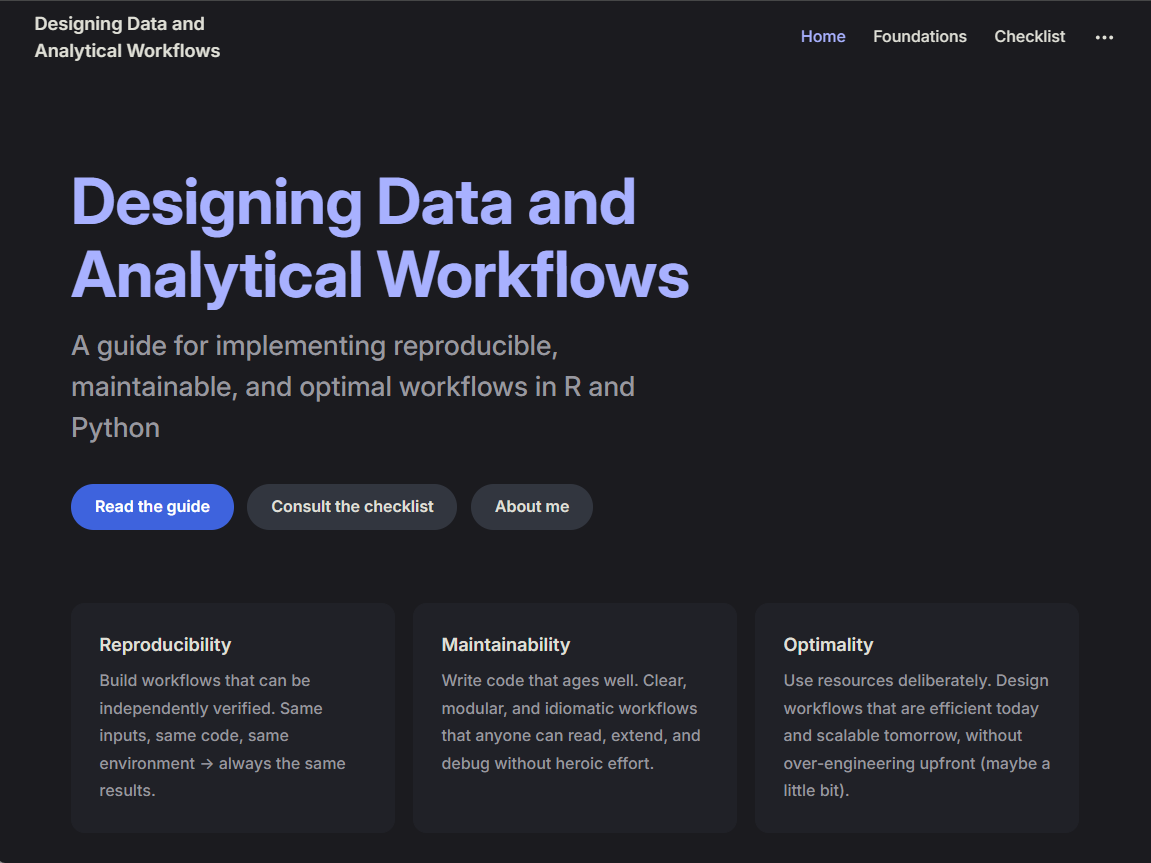
A practical guide to building reproducible, maintainable data workflows.
What it’s about
A practical, opinionated guide to building data and analytical workflows that are reproducible, maintainable, and optimal — written for analysts, researchers, and data scientists who write code to work with data but may not come from a formal software engineering background. It’s a living book, not a one-off tutorial: content is added and revised as tools evolve and new lessons accumulate.
Read it online: ctoruno.github.io/data-analytics-workflows
What it covers
The guide is organized around three core principles:
- Reproducibility — openness, portability, and traceability
- Maintainability — readability, modularity, observability, and idiomaticity
- Optimality — efficiency and scalability
Examples are primarily in R and Python, though the principles themselves are language-agnostic — Stata and Julia coverage is planned.
Stack and how it was built
The book is a VitePress site: Markdown files under docs/ each become a page, with the file path determining the URL, and navigation controlled separately in docs/.vitepress/config.mjs. There’s no backend or database — the build output is a folder of static files, deployed to GitHub Pages.
Publishing is fully automated: every push to master triggers a GitHub Actions workflow that installs dependencies, runs the VitePress production build, and publishes the result. Two details keep the deploy correct — the base path in the config matching the GitHub Pages subpath, and a .nojekyll file so GitHub Pages doesn’t mangle asset filenames that start with an underscore.
License
The written guide is licensed under CC BY-NC 4.0 (share and adapt freely, with attribution, for non-commercial use); the code samples and site configuration are MIT licensed. Feedback, corrections, and contributions are welcome via issues or pull requests on GitHub.